Have you ever felt someone is standing too close to you? You move away because your sixth sense registers discomfort or danger. Or maybe you're on a train or a bus and you can't move away, but now you're alert and your focus is on the space between you and the other person.
Or have you ever tried to throw a crumpled paper into a basket from afar? You may miss but it comes pretty close; it's not that far. It may be too high or too low or a bit short but it's not far at all, and so you try again.
In both cases, you are using your innate sense of distance.
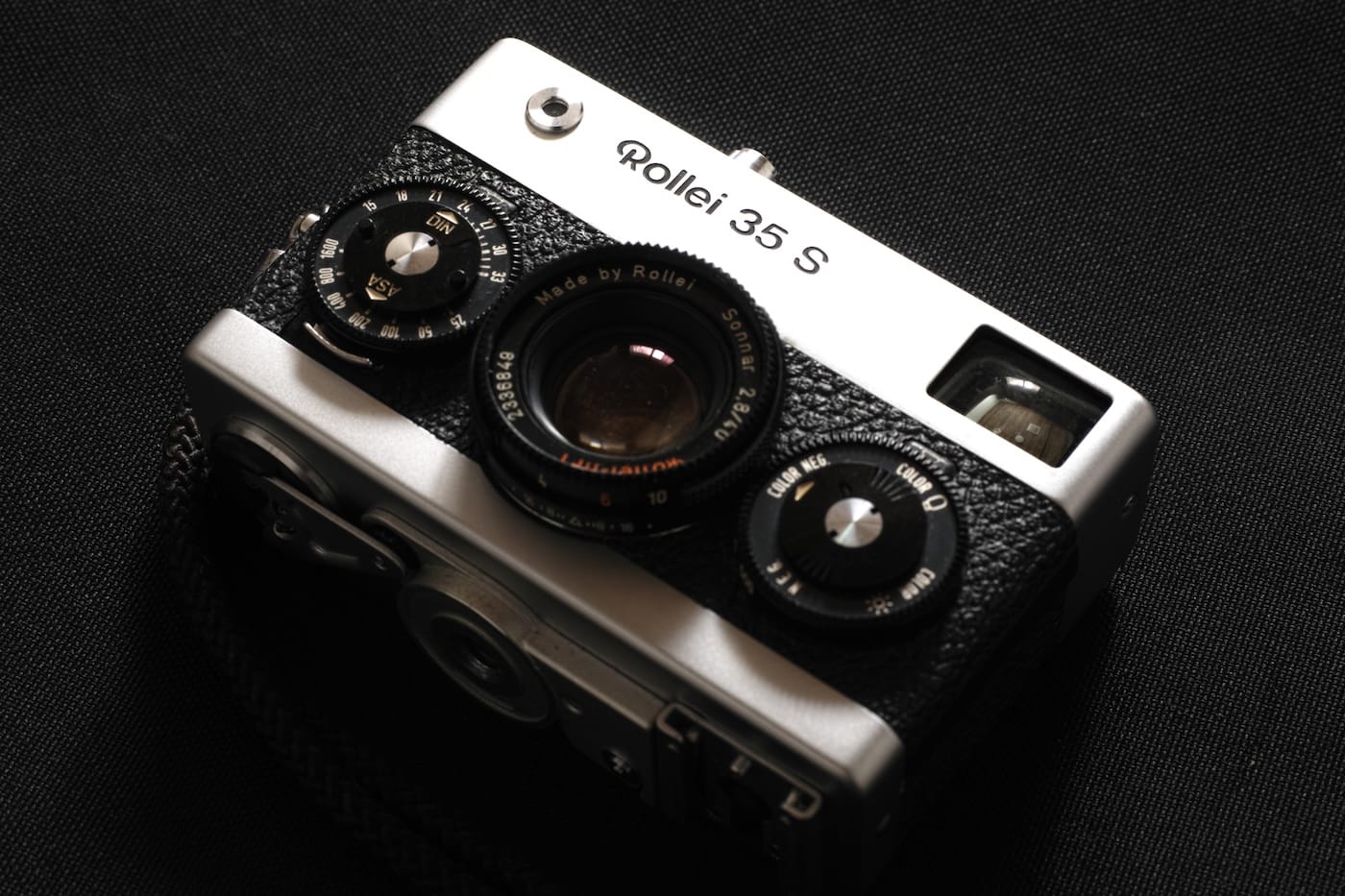
In this article, I will show you how I guess the distance (also called zone-focusing) when I shoot with the Rollei 35 film camera, which lacks a rangefinder or any way to measure the distance to your subject.
Limitations
But before we get into that, why would you pick up such a camera in the first place? I have always been intrigued by compact cameras because they represent the near-impossible ideal of "everything" in as tiny a form as possible. With all man-made devices, though, everything has a trade-off. We accept limitations in exchange for a combination of features that we would not be able to find if the said limitation was removed. With the Rollei 35, we have a fully manual film camera with a light meter, a well-regarded Carl Zeiss Sonnar 40mm f2.8 lens and shutter speeds up to 1/500, in a compact form that also looks aesthetically pleasing. It doesn't hurt that its German heritage also competes effortlessly with the other German giant, Leica.
I had already been using a Leica M2 and often had to judge distances by eye despite that camera having a rangefinder, because it was just too slow to put the camera to my eye in case my "prey" got away. But it was easier, too, because I was using a 21mm lens, which, with its deeper depth of field, was much more forgiving if my guesstimate was off. The Rollei 35's 40mm lens is not as forgiving, so I have to be more careful and less cavalier.

Guessing distances
The first thing I did was to measure the length of my arm. It is about 70cm or 0.7 meters. The minimum focus distance on my Rollei 35 (The 'S' model) is 90cm or 0.9 meters.
Now, all I need to do is point my arm at a subject and I can visually assess how many arm lengths away they are and then multiply it in my head. Two arm lengths is 1.4 meters. I don't point my arm at people, of course, but I sometimes point my arm at things that are as far away as the person is, such as a vending machine that might be on my left. Mostly, I imagine myself pointing my arm and that helps me guess even better. After all, this is a visualization game.
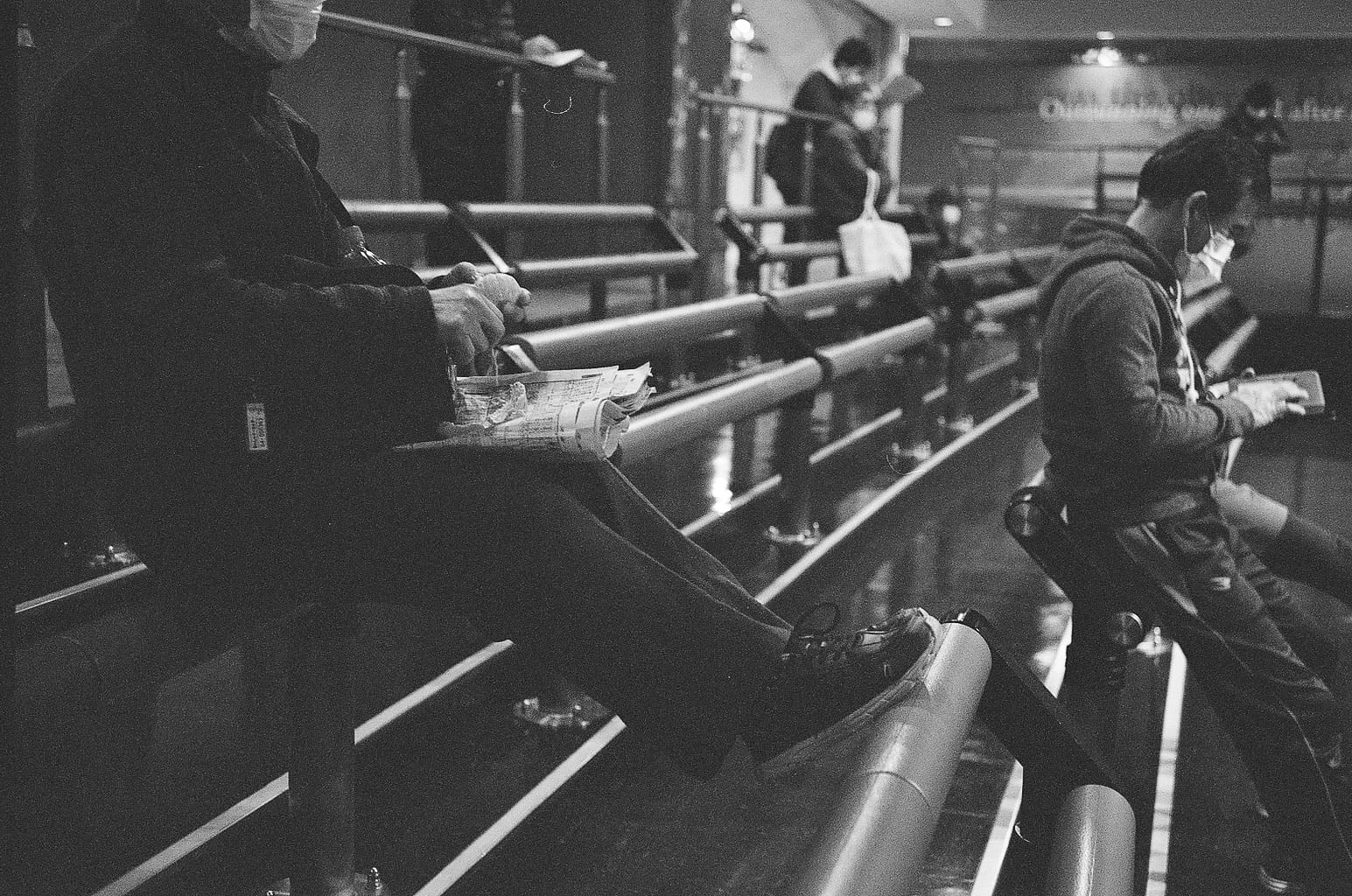
The second thing is to have a point of reference in a place you frequently are. Taking trains in Tokyo, I have measured with a rangefinder that the person sitting directly across from me on a train is 1.7 meters away from me. I just memorized that one number. If someone is standing diagonally across from me on a train, I know that they are farther away from me than the person directly in front of me. So I estimate the difference and add an arm length. You have to estimate. You chose a camera without a rangefinder and now you must play the game of estimation.
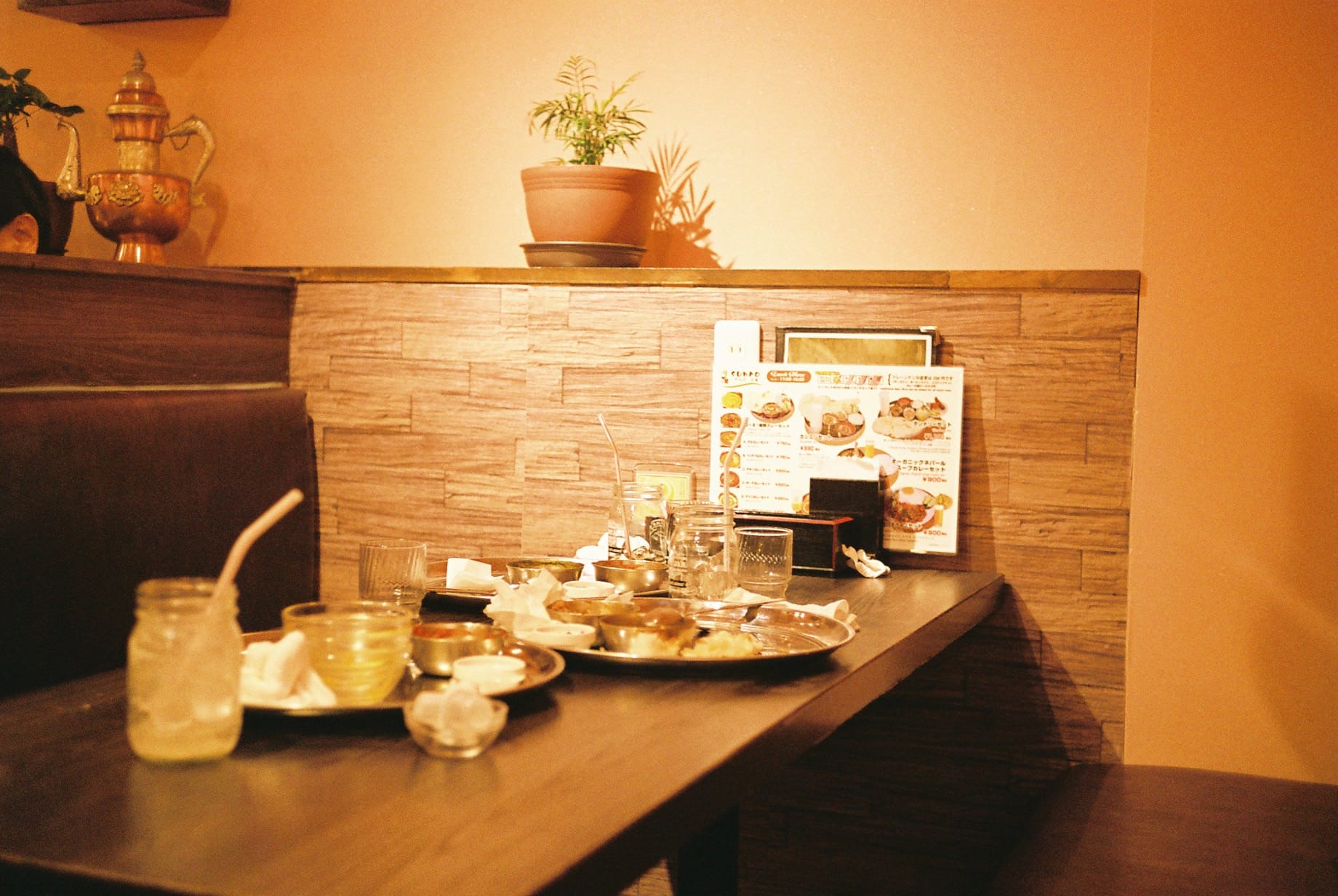
Once you have that point of reference, wherever you may be, you can visually compare it in your mind. A person in a restaurant might be 2.5 meters away from you, so you imagine them on a train and right away you can guess that they are further away than 1.7m, and then you start adding arm lengths.
At night, shooting at f2.8, I just set my camera to 10 meters or infinity if I'm shooting into the distance. If I have to shoot a subject close to me, then I accept my limitations and simply take my best guess, trusting myself as an archer trusts their aim.
The Rollei 35S is marked with distances at 0.9m, 1m, 1.2m, 1.5m, 2m, 3m, 6m, and infinity. It doesn't have click stops so I am forced to look down at it, but there are times when I have changed focus without looking down because things were moving too fast. I simply trusted that just a little turn was sufficient to increase the focusing distance. When you play this game, you must trust yourself.
- Camera
- Rollei 35S
- Best Aperture
- F8
- Comfortable Speed
- 1/15
- Requires Effort
- 1/8
- Requires Panning with Subject
- 1/4
Depth of field and lower shutter speeds
The more you stop down, the higher your probability of hitting focus. After all, this camera is not made to shoot portraits at f2.8 and get nice bokeh, though you can do that with an external rangefinder if you really want to. I simply stop down as much as the light conditions will permit.
I've found that f8 is the optimal aperture value to set if you want to take advantage of depth of field, and even then, it isn't very generous. So that means you need to also get comfortable with hand-holding slower shutter speeds.
When holding the camera in both hands, I brace myself (with my elbows or shoulder) against something. I try not to breathe and press the shutter button slowly, and I don't release it until I have heard the click. Getting down on my haunches and resting my elbows on my knees is another trick I use. The closer I am to the ground, the more stable I feel.
Using this technique, pictures down to 1/8 are doable with some effort, while 1/15 can be comfortably handheld. If I have to go down to 1/4 then I'll try to pan with the subject's movement.
Conclusion
Guessing distances is not as hard as it sounds. We do much harder things for our love of photography and film. The key is to start and then develop the skill through practice. You'll be surprised at how nice it feels and how fast you'll be able to respond to changes on the street. Plus, this skill can be used with any camera and with most focal lengths below 50mm.