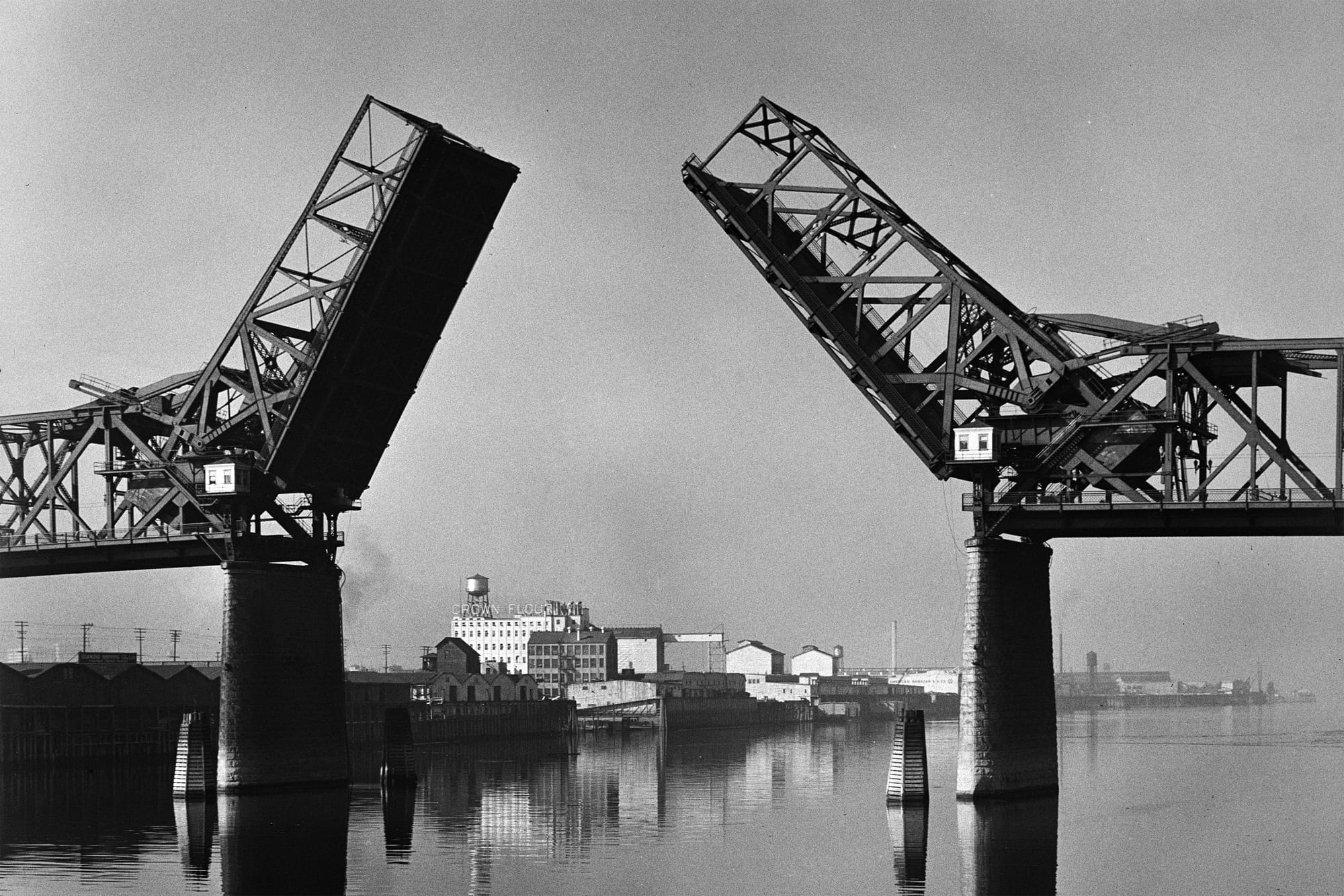
When the photographer makes a picture they are not obliged to first stare at a blank page. The world in all of its vitality and confusion, a swirling mass of colors, action, and gesture first confronts us. From the chaos of life the photographer must pull from it an image, one that reveals something about the world and possibly themselves. But how do they begin? How does one learn the craft of capturing light and making such images?
In our previous installment of "Ways of Seeing", we saw how the program at the California School of Fine Arts offered one approach to answering this question, and we argued that it has continued relevance and is still worthy of study. In this installment, we hope to demonstrate why.
Making pictures, reading pictures
In the Minor White archive there are two documents that explain the difference. In his course outline of 1950 for CSFA, "General Aims of the Department", he describes the photographer’s approach to their subject matter, and how forming a mental model as one first engages with subject matter can be a helpful orientation. In 1957, writing with Walter Chappell for Aperture, he presented "Some Methods for Experiencing Photographs", where we are now oriented as viewers, either of the work of others or our own, and must try to analyze, evaluate, and make sense of what is presented to us.
The latter should not be used without the former, or, even worse, in place of it. To provide one example of this tendency, we can point to an influential essay by Terry Barrett, "A Theoretical Construct for Interpreting Photographs", whose framework was intended to replace older categorization systems such as White's from 1957. Barrett states that the system's "primary purpose… is as a heuristic framework of questions with which viewers can interpretively approach any photograph." This is fine as it is, but this approach does not include an adjacent process that takes the photographer's perspective, the one where they must face the bewildering complexity of the visual world they confront.
But the real difficulty occurs when the primacy of the viewer, who consumes images, is used as a methodology for teaching the making of photographs. Barrett boasts, "The system has been successfully used as a curricular model for teaching photography as a studio activity," and so we end up with critics teaching artists how to learn their craft.
Barrett also claimed that his system was "based on an analogy of visual images and verbal statements," which in itself is not a bad idea and was an approach that Leonard Bernstein used in his Norton Lectures at Harvard University where he analyzed music by way of Chomskian Universal Grammar. But where Bernstein incorporated techniques from musical composition into his analysis, such as retrograde and inversion, Barrett does no such thing. His categories (Descriptions, Explanations, Interpretations, Ethical Evaluations, Aesthetic Evaluations, and Theoretical Photographs) have already been mediated by theoretical intervention and consumption. For example, “Ethical Evaluation” names a kind of verbal statement; White’s approaches describe relationships the photographer can actively take toward a subject.
To give another example of the verbal, critic-centered approach of Barrett, under the category of "Theoretical Photographs" he places a work by Sherrie Levine, After Walker Evans, which raises questions about art and originality. But this describes its function as an image, rather than the photographic approach used to address the subject, which is more accurate to call copy work. Such a photograph requires the technical ability to set up copy lights to avoid glare, careful camera placement on a tripod, and so on. The photographic category is therefore White's Mechanical Recording while the image itself can be Theoretical. The salient point is that there is no restriction on how we may address our subject matter that a so-called theoretical approach describes or must by necessity entail. They are two separate things.
The second pass
In contrast to this rigidity, which can box us in before we even start, White addresses categorization from the viewer's perspective for this second pass as a heuristic for learning to read photos (not how to make them): "Postpone judgment! When starting to read, experience or take part in a photograph (or picture of any kind) first put aside both like and dislike. Leave criticism to the last, or better still forget to criticize."
The essay from 1957 further elaborates upon White's "Craftsmanship of Communication" from 1950, which is light on details in the Aims document but was surely a part of instruction. The essay describes a process that places the viewer in the correct frame of mind in order to evaluate and think about a photo. The four categories he used for this process are referred to as loose, like a hospital gown. We are in very different territory than that of Barrett. These categories represent a critical approach to viewing photos but are not the product of a critic. What is important is what the photographer takes away from the exercise and then incorporates into the next series of photographs.
Following Ansel Adams, White believed photography education should follow the conservatory model and emphasize hands-on instruction. There is an osmotic aspect to such learning which can only be alluded to here, but the other part of this instruction included spending a lot of time looking at and analyzing photos. However, it must be remembered that, when photographing, the engagement with the world is ultimately a personal one. Adams repeats this several times in his book, Examples: The Making of 40 Photographs. Although Adams is thought of in the popular imagination as a technician, he makes it very clear that the photographic process is best made in a state of flow: "When I am making a photograph I do not entertain critical attitudes; analysis is helpful only after a picture is made."
White's methodology, then, can be considered a loop with two passes: how to think about the subject and engage it; then, how to put your assumption aside and accurately read what a photograph actually contains. After the cycle is complete, it starts again.
Five approaches to a subject
For the moment, however, we want to focus on the initial engagement with the subject, the part that is often missed in contemporary art education. According to White's schema from 1950, when confronting their subject the photographer has the following options available to them:
2. Craftsmanship of Feeling includes
A. Five approaches to subject matter
1. Mechanical recording. Accurate rendition of substance throughout, and the utmost respect for the identity of each object.
2. Objective Interpretation. Respect for identity of object plus the same for the essence of spirit. Faithfulness to original appearance altered if necessary to state truth of the meaning. The personality of the artist is injected sparingly and preferably not at all.
3. Impressionistic. Recording the effect of subject on artist without regard for spirit or identity of subject.
4. “Equivalent.” Conscious use of subject matter to illustrate states of mind or ideas of the artist which are not related to the original subject. Design and/or subject becomes equivalent to a mood.
5. Subjective or “Free Photographing.” Uncritical seeing at the time of exposure —or instinctive seeing—that reveals the personality of the artist. The results sometimes prove psychological signposts instead of works of art.
These options are less final categories than actions a photographer may take to address a subject. They are active, not passive choices or categories into which a finished photograph is placed. Let's take a real-life example to demonstrate the implications.
I am a street photographer and on my next outing I want to approach my photography around one of these categories. I consider them one by one.
Mechanical recording. I decide to shoot at f/8 or f/11 with a 50mm or 35mm lens so as not to distort the perspective. I avoid unusual points of view and avoid heavy shadows and exposures that hide important details.
Objective Interpretation. This approach is much like the former but I will make whatever alterations are necessary so the object is presented with more clarity. So, if that means separating my object from the background by way of aperture, or cropping out extraneous elements that intrude on the object, I will do so.
Impressionistic. Here I explore my environment and attempt to capture the impression it makes upon me. My attention is drawn to things like color, shape, texture, shadow, detail, and my concern for the object as an authentic entity is not my main concern.
“Equivalent.” Observing my environment, a feeling takes hold of me that is more than the sum of the visual elements I see. I attempt to use the creative potential explored in the previous approach to express this feeling by way of metaphor rather than authentic rendering of the thing itself.
Subjective or “Free Photographing.” On the street I photograph instinctively, without mediation between my experience and the pressing of the shutter. I want to capture fleeting moments that come and go in a split second. Technical concerns like composition or even the effects of aperture do not enter into my mind, which is in a pure state revealing instinctual or internal motivations beyond conscious intent.
Each of the above represents an attitude to one's subject that ultimately impacts how the body moves in space, how the camera is handled, how the hand reacts to the eye. Although ideas are important, they must be expressed through one's material, and the categories above orient that process. Dewey's metaphor from Art as Experience is that the "juice is expressed when grapes are crushed in the wine press." Wine, for example, may be conceptualized as terroir but that quality must be first made materially present.
The camera points both ways
Freeman Paterson's phrase "The camera points both ways" was probably inspired by White's "All photographs are self-portraits" but is, nonetheless, one of the more memorable insights about photography. When we analyze our photos, we look at technical issues like "composition rules" or other details like focus and even development, but we also analyze our feelings toward our subject and how, or if, they are reflected in the photograph. Do we detect common themes in what we are drawn to photograph? Do certain angles or approaches bring us closer or farther from our subject?
In his essay "Your Concepts Are Showing" White presents the idea that a photographer may approach photography in two distinct ways: camera-as-brush and camera-as-extension-of-vision. The difference between the two defines the history of photography and is a continuum along which all photographers are positioned. There are those who like to feel the effect of the hand intervening in the photograph. This can be a manipulation during or after exposure, an intervention of materials or printing surfaces, or even physical alteration of the photo or negative itself. The photo leaves a visible trace of handiwork. The camera-as-extension-of-vision uses the camera's unique abilities as a recording mechanism, relying on it alone to do intrinsically what the other approach does extrinsically. Neither approach is better than the other, and we may individually land somewhere between the two, but each lays claim to a contrasting point of view, approach to images, and perhaps life. So much of what we photograph depends on the way in which we approach it. Your concepts are revealed to the viewer, but have you observed how they have also been revealed to you?
GP